.NET 10
Minimal APIs, Mediator.SourceGenerator, and C# 14 on the latest LTS — compile-time generated, zero reflection overhead, instant startup.

BitzOrcas.Modern turns module boundaries, CQRS vertical slices, unified authorization, multitenant isolation, CAP eventing, workflow engines, multi-ORM dual-engine persistence, and AI-Native MCP protocols into composable templates. Teams use ProfileChoice to select business shapes, tenancy modes, and platform extensions, choose SqlSugar or EF Core as the runtime adapter, and generate a Consumer Solution that owns its business source without leaking framework internals.
Local topology orchestrated and observed through .NET Aspire
3
Minimal API, single-tenant business, and multitenant business define the Host, tenancy, and deployment baseline
6
Authorization, MasterData, Finance, HR, Auction, and Legal
15
1 minimal API, 7 single-tenant business, and 7 multitenant business combinations
37
Identity, authorization, workflow, AI agents, files, search, auditing, legal connectors, and more
The framework provides source- and test-verified defaults while identifying capabilities that depend on provider, topology, and operations evidence. Replacements must pass the same contracts and parity gates.
Minimal APIs, Mediator.SourceGenerator, and C# 14 on the latest LTS — compile-time generated, zero reflection overhead, instant startup.
Command writes are driven by SqlSugar/EF Core adapters with built-in tenant filters and audit; read models query Dapper replicas directly.
One command brings up SQL Server, Redis, RabbitMQ, OTLP Collector, and the API.
A reproducible container baseline with probe endpoints; production still validates secrets, restore, capacity, and multiple replicas.
Local storage for development and an S3-compatible adapter for production; verify metadata, hashing, and presigned semantics per provider.
Tenant aggregates are isolated by default and platform-wide rows are explicit; ORM, cache, jobs, and search are verified separately.
ORM-neutral runtime with dedicated contracts for JSON DSL, versions, deployment, tasks, history, and recovery.
[GenerateMcpTool] compile-time tool generation streamed via /mcp endpoints under strict tenant scoping and permission gates.
Desktop visual suite integrating ER data modeling, database DDL diff inspection, Git timeline auditing, and architectural testing.
The same bitzorcas-host template generates 15 supported combinations. ProfileChoice determines the business shape, tenancy mode, platform or industry extension, and deployment. RuntimeAdapter only selects SqlSugar or EF Core; it does not create another template combination.
$ dotnet new bitzorcas-host -n Acme.Crm \
  --ProfileChoice default-business-multi \
  --RuntimeAdapter sqlsugar
Deterministic output
COMPOSITION MODEL
ProfileChoice determines the Host, module, tenancy, and deployment closure. RuntimeAdapter only switches the production ORM; it does not create another template combination.
mini-api-single
The smallest API Host closure, without a Platform module or industry extension.
default-business-single
An API Host plus a Consumer-owned Starter module in a governed baseline closure.
default-business-multi-authorization
The multitenant Aspire closure explicitly adds the Authorization runtime module.
default-business-multi-legal
Adds the supported package-only Legal extension to the standard business closure.
Each module owns its Contracts, Domain, Application, Infrastructure, and Endpoint surface; other modules depend only on public contracts. Use cases are organized around Commands and Queries, keeping generated endpoints, validation pipelines, aggregate behavior, and test evidence traceable instead of scattering business logic across controllers, services, and repository scripts.
Modular monolith
Cross-module calls go through *.Contracts only — enforced by architecture tests.
Vertical slice
Platform.Catalog/ Application / Commands/ CreateCatalogItem
Endpoints are generated from attributes; authorization, validation, transactions, and audit stay in pipelines so the Handler expresses the use case.
The Consumer Solution is physically separated from the product repository. Product teams own business modules and Hosts; Framework and Platform provide stable capability through commercial packages. Cross-module work uses public Contracts, Ports, Integration Events, or authorized read models, while architecture tests prevent dependency drift.
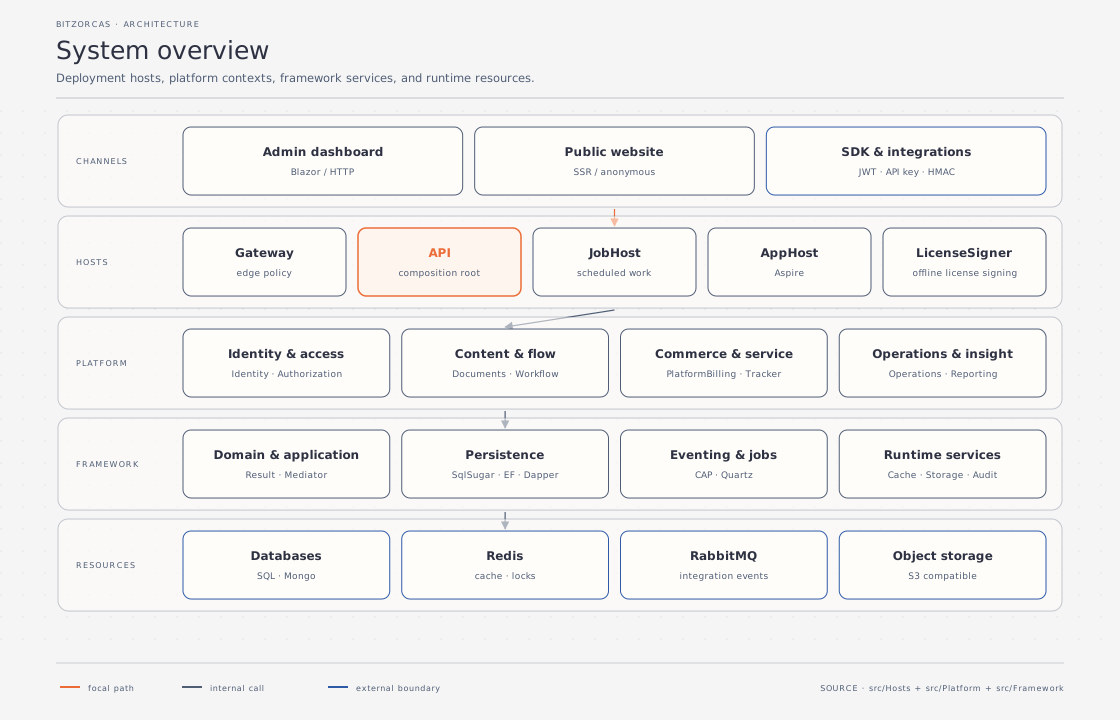
Channels, Hosts, platform modules, framework services, and external resources are layered explicitly. Open the zoomable full view for detail.
Open the interactive architecture viewPACKAGE BOUNDARY
Business code can compose platform capability without copying, modifying, or reaching through its internal implementation.
<!-- Consumer references a Profile package; Platform core source is never copied -->
<ItemGroup>
  <PackageReference
    Include="BitzOrcas.Profile.Default.Business" />
</ItemGroup>Synchronous calls depend only on public contracts; stores, policies, and adapter differences enter through explicit seams.
Cross-module state changes publish through the CAP Outbox, and consumers remain idempotent under at-least-once delivery.
Modules may not reference internal layers, update another module’s tables, or inject a Handler as a cross-module shortcut.
Authentication, authorization, caching, eventing, jobs, observability, idempotency, webhooks, multi-ORM adapters, and AI agent protocols are provided as shared building blocks. Each capability has an explicit default, extension seam, degradation behavior, failure semantics, and production acceptance boundary so business modules do not rebuild cross-cutting infrastructure.
JWT bearer + HMAC client secret, unified authorization decision service (RBAC + ABAC + ReBAC).
Explore the capability boundaryTenant aggregates are isolated through global QueryFilters, while system data uses explicit exceptions; SingleTenant and MultiTenant modes are supported.
Explore the capability boundaryDefault SqlSugar with optional EF Core adapter; built-in tenant scoping, soft delete, optimistic concurrency, and audit interceptors; Dapper direct replica reads.
Explore the capability boundaryDistributed L1/L2 cache with tenant-scoped cache-busting on writes.
Explore the capability boundaryExplicit transactional publishing enters the CAP Outbox; consumers remain idempotent under at-least-once delivery.
Explore the capability boundaryTraces, metrics, and logs are exported through OTLP; changing the backend validates configuration, field mapping, sampling, and alerts.
Explore the capability boundaryVersioned Minimal APIs, OpenAPI 3.1 docs, interactive Scalar UI.
Explore the capability boundaryIdempotency pipeline, HMAC-signed webhooks with retry, delivery log, and DLQ.
Explore the capability boundaryLocal orchestration of API + SQL Server + Redis + RabbitMQ + OpenTelemetry collector.
Explore the capability boundaryPersistent scheduled jobs and CAP message consumers with tenant context preserved.
Explore the capability boundaryProbe endpoints, partitioned rate limits, jobs, and management diagnostics; a general SSE channel is not shipped.
Explore the capability boundaryMicrosoft.FeatureManagement with tenant-scoped overrides.
Explore the capability boundaryORM-neutral runtime covering JSON DSL, versions and deployments, tasks, history, and recovery boundaries; applications compose their own approval rules.
Explore the capability boundaryGenerate DI, Endpoints, ORM mappings, and Query Shapes so recurring architecture rules move into compilation.
Explore the capability boundaryPackage Entitlement, Runtime License, and tenant Features are separate models; commercial modules use one fail-closed decision seam.
Explore the capability boundaryModel Context Protocol implementation compiling tool schemas via [GenerateMcpTool]; streams through the /mcp endpoint strictly within tenant isolation and permission gates.
Explore the capability boundaryDesktop visual workbench integrating ER data modeling, database DDL diff inspection, Git commit timeline auditing, and architectural rule compliance.
Explore the capability boundarySupplies WeChat.Mp enterprise connectors, LegalCalculators for court fees, Timekeeping for billable hours, GDPR privacy compliance, and document generation.
Explore the capability boundaryThe product repository contains 37 Platform source boundaries covering identity, authorization, files, notifications, workflow, search, reporting, operations, legal connectors, and the support helpdesk. Consumer templates expose only modules and extensions included in supported combinations; business modules still depend only on public Contracts.
Unified auth. Multiple strategies.
Isolation by default. Cross-tenant by opt-in.
A forensic record of every change.
Object Storage (S3)
Tenant-scoped object storage adapters (MinIO / S3 / Local) with uniform metadata and presigned URL semantics.
Async Export Center
Asynchronous big-table paging export, progress tracking, file persistence, and multi-channel completion callbacks.
Full-Text Search
Elastic / OpenSearch cross-module unified index building with authorization filtering.
Document Serializer
High-concurrency document numbering engine with per-tenant date segmentation, separating rules from counters.
Webhook Dispatcher
HMAC signatures, exponential backoff retries, delivery audit logging, and dead-letter queue recovery.
Notification Hub
Unified user inbox with multi-channel routing pipelines across internal, email, SMS, and WeChat channels.
Dynamic Form Schema
JSON Schema-driven form metadata with runtime field-level cascading validation and tenant overrides.
Business Tags
Tenant-scoped universal entity tagging, hierarchical inheritance, inverted indexing, and multi-dimensional aggregation.
Legal Calculators
Precise litigation court fee bracket calculations, statutory lending interest, and penalty compounding.
Timekeeping & Billing
Professional matter billable hours logging, multi-rate tiers, approval workflows, and invoice staging.
Document Engine
Template-driven PDF and Word document assembly for contracts, judicial filings, and compliance reports.
GDPR & Privacy Compliance
PII personal data auditing, transparent field masking, export archiving, and right-to-be-forgotten erasure.
Built on .NET 10, SqlSugar, EF Core, CAP, MCP, and mature OSS, with a self-built workflow engine, compile-time source generators, and architecture tests that encode team constraints. Every boundary has a concrete source and verification entry point.
.NET 10
C# 14 · net10.0 LTS baseline
Aspire
latest · Local orchestration
SqlSugar
Core · High-throughput command engine
EF Core
optional · Compliance & audit adapter
Dapper
replica read · Replica read pushdown
CAP
latest · Transactional outbox
Mediator
sourcegen · Compile-time CQRS pipeline
SourceGen Mapper
zero alloc · Zero-reflection DTO mapper
FusionCache
L1/L2 · Tenant-scoped L1/L2 cache
Quartz
clustered · Persistent clustered jobs
OpenTelemetry
OTLP · OTLP traces, metrics & logs
Scalar
OpenAPI 3.1 · OpenAPI 3.1 browser
ArchUnitNET
187 tests · 187 executable architecture tests
MCP Server
Agent tools · Model Context Protocol tool streaming
BitzOrcas.Suite
Workbench · Desktop ER, DDL diff & review suite
Workflow DSL
JSON schema · Declarative JSON state machine
The authoritative merge gate covers formatting, Release compilation, domain behavior and integration tests, module boundary isolation, Consumer PackageReference verification, trim publish, Roslyn reflection checks, No T-SQL dialect validation, production deployment assets, and OpenAPI/SDK drift. Template changes independently run the 15-combination × 2-ORM generation matrix; external Commercial GA validates trusted signatures, SBOM, and production Consumer execution.
26
Test projects
26 solution test projects cover domain invariants, Result/Error contracts, pipeline behaviors, and real SQL Server and RabbitMQ paths.
187
Architecture test files
187 executable architecture test files enforce layering directions, module boundaries, Host purity, AOT trims, reflection rules, and persistence.
15
Supported combinations
All 15 template combinations run deterministic generation and closure checks under both SqlSugar and EF Core; strict subsets verify private-feed builds.
GA
External Commercial GA
Authenticated feeds, trusted signatures, SBOM manifests, vulnerability policies, and external Consumer verification independently guard release.
$ scripts/build/verify-all.sh
  01—04  secret · restore · format · Release build
  05—08  unit/non-Docker · Consumer Contract · XML
  09—10  architecture · integration (non-Docker)
  11—13  trim publish · reflection zero · No T-SQL
  14     production deployment and portability assets
  15     OpenAPI artifact · platform-sdk drift
  MERGE GATE  ·  15 required steps

$ scripts/build/verify-template.sh
  15 combinations × 2 ORMs — SqlSugar / EF Core
  TEMPLATE GATE  ·  run when templates or releases change

$ scripts/build/verify-commercial-ga.sh
  authenticated feed · trusted signatures · SBOM
  vulnerability/license policy · provenance · external consumer
RELEASE GATE · immutable artifacts onlyBitzOrcas.Modern fits .NET backends that need long-term evolution, module governance, and consistent delivery evidence. The current public template ranges from a minimal single-tenant API to single- or multitenant business systems with supported platform or industry extensions.
A good fit
Minimal APIs and integration shells
mini-api-single provides a minimal single-tenant API closure for Consumer-owned business surfaces built on stable Framework contracts.
Single-tenant internal and business systems
default-business-single generates an API and Consumer-owned Starter module, with supported coupled choices for Authorization, MasterData, or industry extensions.
Multitenant SaaS business systems
default-business-multi uses authenticated tenant claims and an Aspire deployment closure while the Consumer team retains business-module source.
Products needing governed platform or industry extensions
Authorization, MasterData, Finance, HR, Auction, and Legal use explicit coupled presets instead of placing unverified free-form composition in customer repositories.
Not a fit
Frontend-only projects
BitzOrcas.Modern is a backend architecture baseline. It doesn't include frontend frameworks or UI components — pair it with your frontend stack.
Teams that require unrestricted combinations
Canonical templates use a fail-closed composition matrix. The public entry accepts only registered ProfileChoice and RuntimeAdapter values rather than allowing an arbitrary closure merely to generate something first.
Microservices-from-day-one scenarios
BitzOrcas is a modular monolith — modules can be extracted into services later, but it ships as one process. If you need independently deployed services on day one, plan accordingly.
Teams not using the .NET stack
All architecture patterns and technology choices are based on the .NET 10 ecosystem. Non-.NET teams can reference the architectural ideas but cannot directly reuse the code.
Clear answers about composition, extensions, isolation, persistence, and delivery gates. If an architectural decision remains open,submit an Issue
Use mini-api-single for a minimal API. Choose default-business-single or default-business-multi for a normal business system based on tenancy. Add the coupled Authorization, MasterData, Finance, HR, Auction, or Legal suffix when that supported closure is required, then select sqlsugar or efcore separately as RuntimeAdapter. The public CLI rejects free-form combinations outside the matrix.
No. A Consumer Solution owns its Hosts, composition manifest, configuration, tests, and business-module source. Framework and the default Platform arrive through commercial PackageReference. Product differences enter through Contracts, Store Adapters, Policies, Strategies, Options, Integration Events, or Pipeline Hooks.
The public template exposes only ProfileChoice and RuntimeAdapter. ProfileChoice couples the Host, module, tenancy, and deployment closure; those parts are not free-form overrides. RuntimeAdapter selects sqlsugar or efcore. A new closure must first enter the single composition catalog and template matrix, then pass isolated-feed and Consumer Contract gates.
Single tenancy retains the unified tenant contract with a fixed context. Multi tenancy adds resolution, lifecycle, DataScope, per-tenant cache, throttling, audit, and operations. If multiple customers share data infrastructure, start with multi and test isolation across ORM, cache, jobs, search, and administrative paths.
Synchronous capability references only the target *.Contracts or an explicit Port. State changes publish Integration Events through the CAP Outbox. Queries use authorized Query Contracts, read models, or Reporting Marts. References to another module’s Domain, Application, Infrastructure, or internal tables are forbidden.
The template has 15 supported combinations. Each is verified with both SqlSugar and EF Core, producing 30 physical generation paths without increasing the template-combination count. An adapter must still preserve Store contracts, Result/Error semantics, tenant isolation, transactions, and provider parity. Dapper handles high-performance query projections from read replicas rather than acting as a standalone template RuntimeAdapter generation parameter.
The authoritative entry is scripts/build/verify-all.sh. It executes 17 strict gates: secret scanning, restore, code format and unused using checks, Release build, unit/behavior tests, local PackageReference Consumer contract tests, XML docs and comments, architecture test suite, non-Docker integration tests, rate-limiting and anti-forgery stress tests, golden CLI channel validation, trim publish, Roslyn semantic reflection checks (ADR 0102/0103), No T-SQL dialect gate (ADR 0033), production deployment asset verification, and OpenAPI specification plus Platform SDK client drift checks.
No. Commercial GA is a separate external gate over immutable artifacts: authenticated private feed, trusted signatures, SBOM, vulnerability threshold, third-party license policy, provenance, and an external Consumer Solution. Each customer topology still proves capacity, security, recovery, and multi-replica behavior.
BitzOrcas natively supports the Anthropic Model Context Protocol (MCP). Marking use cases or services with [GenerateMcpTool] triggers the compile-time source generator to produce JSON schemas streamed via the /mcp endpoint. When an AI agent invokes a tool, requests pass through unified authentication middleware to inject the caller’s TenantContext and SecurityPrincipal, enforcing strict DataScope rules and global tenant query filters. Agents are strictly prohibited from issuing raw SQL or bypassing aggregate boundaries; all mutations must traverse CQRS validation and audit pipelines.
Domain and Contract layers remain 100% ORM-neutral, depending solely on ICommandRepository write ports and I*ReadStore read ports. Command write paths are driven by the chosen RuntimeAdapter (SqlSugar or EF Core), governing aggregate lifecycles, optimistic concurrency, tenant scoping, and audit interceptors; complex reporting and high-frequency read models utilize IDapperConnectionFactory to query read replicas directly, uniting clean architecture with extreme query throughput.
Choose a supported ProfileChoice and RuntimeAdapter. The CLI generates the Consumer Solution; the product team owns business source while Framework and Platform evolve behind stable contracts and commercial packages.